
Special Educational Needs and Disabilities (SEND)
SENDCO: Miss Georgina Sedgwick
SEND Link Governor: Mr Lee Reed
At Longstone School we are committed to providing high quality education for all learners so that they:
- are nurtured to become confident learners
- a passion is ignited inside them to achieve their best
- leave our school as successful and well-rounded young people who shine lights into the wider world.
We teach SEND children in our mainstream setting. All of our pupils are entitled to the same High Quality Teaching and have equality of access to the curriculum.
As a school we support the Local Offer made by Derbyshire Authority in relation to their commitment to delivery the Children and Families Bill 2014. More information on this can be found at www.derbyshiresendlocaloffer.org.
Please read our SEND Information Report below for further information.
Who are the best people to talk to in this school about child’s difficulties with learning/Special Educational Needs or Disability (SEND)?
Your Child's Class Teacher
The class teacher is responsible for monitoring the progress of your child and identifying, planning and delivering learning in an adaptive manner. They are responsible for writing pupil progress targets and support plans and sharing and reviewing these with parents. Class teachers are responsible for ensuring that the school’s SEND Policy is followed in their classroom.
The SENDCo
Miss Georgina Sedgwick is our school SENDCO. The SENDCO is responsible for developing and reviewing the school’s SEND policy as well as co-ordinating all support for children with special educational needs or disabilities (SEND). The SENDCO's role is to ensuring that parents/ carers and children where necessary are: i) involved in supporting your child’s learning ii) kept informed about the support your child is getting iii) involved in reviewing how they are doing. The SENDCo will liaise with all outside agencies who may come to school to help support your child’s learning, e.g. Speech and Language Therapy, Educational Psychology. The SENDCO is responsible for updating the school’s SEND register (a system for ensuring that all the SEND needs of pupils in this school are known) and making sure that records of your child’s progress and needs are kept. They ensure the provision of specialist support for teachers and support staff in the school, so that they can assist children with SEND in the school to achieve the best progress possible.
The Headteacher: Mr M Knight.
The Headteacher is responsible for the day-to-day management of all aspects of the school, including provision for children with Special Educational Needs and Disabilities (SEND). In their role as SENDCo, the Headteacher works closely with class teachers to ensure appropriate support is in place; however, they retain overall responsibility for ensuring that all pupils’ needs are effectively met. The Headteacher also ensures that the Governing Body is kept fully informed of matters relating to SEND.
How does the school ensure that children/young people who need extra help are identified early?
Our teachers deliver high quality adaptive teaching and use diagnostic assessment to establish children's strengths and weaknesses on a day to day basis. We use a range of tools to gather assessment information.
If we feel that your child is not making the expected progress, or if class teachers are concerned that your child may need additional or different support over a sustained period of time to help them on their school journey, we will arrange to speak with you.
We will typically discuss any concerns you may already have at home and plan additional support which we feel would benefit your child. This additional support forms a support plan and takes the form of a 4 part cycle: Assess, Plan, Do, Review.
A graduated approach to support recognises that children learn in different ways and have many types and levels of SEND. So increasingly, step by step, our approach will ‘grow’ as we introduce new methods or specialist expertise. Help may be only needed for a short time, for many years or for the whole of their education.
How will the school let me know if they have any concerns about my child’s learning in school?
If your child is identified as not making progress, the school will arrange a meeting with parents/ carers to discuss concerns in more detail and to:
- Listen to any concerns you may have.
- Plan any additional support your child may need.
- Discuss with you any referrals to outside professionals to support your child.
What are the different types of support available for children with SEND in our school?
High Quality Teaching
Our teachers have the highest possible expectations for your child and all pupils in their class. All teaching is built on what your child already knows, can do and understand.
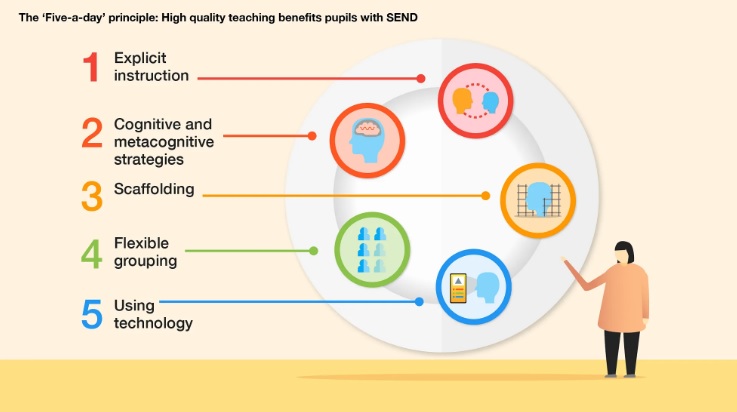
In line with Education Endowment Foundation (EEF) research, teachers use a range of adaptive teaching strategies, applied flexibly to meet the needs of all pupils. These include:
i) flexible grouping
ii) cognitive and metacognitive strategies
iii) explicit instruction
iv) use of technology to support pupils with SEND
v) scaffolding
Carefully Selected Interventions
Targeted group interventions may be used to support your child to make progress. These may take place either within or outside of the classroom.
Interventions are delivered by trained staff, including teachers and teaching assistants (TAs). Our TAs are deployed carefully, drawing on their areas of expertise to achieve the best possible outcomes for each child.
Outside Agencies
At times, it may be appropriate to seek advice or support from specialist external agencies to help your child make progress. This may include services provided by the Local Authority, such as the Inclusion Support Advisory Service (ISAS) or the Educational Psychology Service (EPS).
With your permission, the school may refer your child to a specialist professional, such as a Speech and Language Therapist or Educational Psychologist. This helps both school and parents to gain a deeper understanding of your child’s needs and how best to support them.
Specialists will assess your child’s needs and provide recommendations for strategies and support within school.
Specified Individual Support
This level of support is for children whose learning needs are severe, complex and likely to be long-term. It is usually provided through an Education, Health and Care Plan (EHCP).
An EHCP is issued following a statutory assessment process carried out by the Local Authority. This is requested when it is felt that a child requires a higher level of support than can typically be provided through high quality teaching and targeted interventions (as outlined in the Graduated Response).
The request is considered by a panel of professionals at the Local Authority, who decide whether a statutory assessment is appropriate. If agreed, an EHCP will be issued, outlining your child’s needs, the support required, and both long- and short-term outcomes. If not, the school will continue to provide support at the current level.
In some cases, additional support may also be accessed through Inclusion Panel funding. This may be discussed with you if the school feels your child would benefit from resources or provision beyond what is ordinarily available within the school.
How will the teaching be adapted for my child with SEND?
Class teachers plan and deliver lessons according to the specific needs of all groups of children in their class and will ensure that your child’s needs are met. Our staff use the EEF 5 a day approach to ensure our pupils with SEND make progress in their learning.
Support staff, under the direction of the class teacher, will adapt planning to support the needs of your child where necessary. Specific resources and strategies will be used to support your child individually and in groups. Planning and teaching will be adapted, on a daily basis if needed, to meet your child’s learning needs.
What intervention or support is provided for children with SEND in our school?
At our school, we provide a range of targeted interventions and supportive programmes to meet the diverse needs of children with SEND. These include Lego Therapy, which supports communication, teamwork and social skills, and Forest School sessions, which promote emotional wellbeing, resilience and confidence through outdoor learning. We also offer additional support through our breakfast and after-school clubs, providing structured opportunities for social interaction and routine. Our trained playleaders help to facilitate positive play experiences at breaktimes, encouraging inclusion and friendship-building. In addition, we work in partnership with our Family Support Service to deliver specialised programmes such as Nurture groups and Draw and Talk, which support pupils’ emotional development, self-esteem and ability to express their feelings. Together, these interventions ensure that pupils with SEND are supported holistically, enabling them to thrive both academically and socially.
How are the Staff in school trained to work with children with SEND and what training does the Staff have?
At Longstone, we are committed to ensuring that all staff receive appropriate training and ongoing support to enhance teaching and learning for all children, including those with SEND. This includes both whole-school training and targeted professional development, tailored to the evolving needs of pupils within the school.
Individual teachers and support staff also access specialist training delivered by external agencies, ensuring they are equipped to meet the needs of specific children in their classes. In addition, we work closely with the SSSEN support service, which provides guidance and training in areas such as developing reading and writing, physical literacy, social and emotional needs, and sensory and physical development.
Currently, our staff are trained to deliver a range of interventions, including Lego Therapy and Forest School. We are continually seeking to develop our expertise further, and staff regularly engage in new training opportunities and initiatives in response to emerging needs within the school.
How will the teaching be adapted for my child with SEND?
Our teachers have developed a strong repertoire of adaptive teaching strategies, which they use flexibly to meet the needs of pupils with SEND. These include:
-
Flexible grouping: Pupils are thoughtfully paired or grouped for specific tasks according to their individual needs. Children may work with different peers within their class or across the school to ensure they are in the most effective learning environment to support their progress.
-
Cognitive and metacognitive strategies: Teachers explicitly teach pupils how to plan, monitor and evaluate their learning. They model their own thinking processes to support the development of both cognitive and metacognitive skills. Tools such as KWL grids, graphic organisers and vocabulary lists are used to help pupils become more independent and reflective learners.
-
Explicit instruction: Learning is broken down into small, manageable steps, often supported with clear visual examples. Teachers anticipate and address common misconceptions and use precise, clear language when explaining learning processes and expectations. Tasks are carefully designed to minimise unnecessary distractions, enabling pupils to focus fully on their learning.
-
Use of technology to support pupils with SEND: Technology is embedded across our curriculum. Pupils with SEND use a range of instructional apps to support small-step learning and practise key skills, such as Lexia, Times Tables Rock Stars, Accelerated Reader, Numbots and Spelling Shed. Widgit software is also used to support communication and understanding through the use of symbols and visual prompts. In addition, pupils can access supportive tools such as note-taking apps, word processors and speech-generating applications to aid communication and independence.
-
Scaffolding: Scaffolding provides temporary support to enable pupils to successfully complete tasks they would not yet be able to manage independently. This support may be visual, verbal or written. As pupils’ confidence and competence grow, this support is gradually reduced, promoting independence and long-term learning.
How is progress measured for children with SEND?
Your child’s progress will be closely monitored by their class teacher. Their learning is reviewed each term with the Headteacher and SENDCo in reading, writing and maths. At certain points in primary school (such as the end of Year 2 and Year 6), children complete national assessments (SATs), which all schools are required to carry out.
If needed, your child will have a Support Plan with clear targets set by school staff and/or outside professionals. We review these targets regularly and use them to decide the next steps in your child’s learning.
Children receiving Inclusion Funding or with an Education, Health and Care Plan (EHCP) will have a more detailed review each year, involving parents and other professionals. The SENDCo also monitors progress to ensure your child is supported effectively.
The SENDCo and Senior Leadership Team regularly check that all children are making progress and that teaching remains of a high quality.
What support do we offer as a parent/carer of a child with SEND?
The class teacher is regularly available to discuss your child’s progress or any concerns you may have and to share information about what is working well at home and school, so that consistent and effective strategies can be used.
The SENDCo is available to meet with you to discuss your child’s progress or any concerns/worries you may have. When outside agencies and external professionals are consulted, all information will be discussed with you directly, or where this is not possible, in a report.
Support Plan targets will be reviewed with your involvement and homework will be adjusted as needed to your child’s individual requirements. Each child in school has a planner which is used as a home-school contact book to support communication with you when this has been agreed to be useful for you and your child.
How is our school accessible to pupils with SEND?
Our school is accessible to wheelchair users. The school is single story and access is provided via ramps at each classroom door. We have a large designated disabled toilet space to accommodate wheelchairs and additional equipment as required. Where possible, additional resources will be purchased to support the needs of each individual with SEND. The school is secure access.
How will we support your child joining this school? Leaving this school? Moving to another class?
We recognise that transitions can be difficult for a child with SEND, and we take steps to ensure that any transition is as smooth as possible.
If your child is joining us from another school
For children entering school in their reception year, the SENDCo will visit pre-schools when appropriate. A visual starting school booklet and social story is provided to assist your child in becoming familiar with the setting. Children are encouraged to visit our school and stay for a taster session to enable them to become familiar with adults and the school building.
If your child is moving to another school
We will contact the school SENDCo and ensure they are aware of any special arrangements or support that needs to be made for your child. We will make sure that all records about your child are passed on as soon as possible. If your child would be helped by a visual aid or social story to support them in understand moving on, then one will be made for them.
When moving classes in school:
Information will be passed on to the new class teacher in advance and a planning meeting will take place with the new teacher. Support Plans will be shared with the new teacher.
In Year 6:
The SENDCo will discuss the specific needs of your child with the SENDCo of the child’s allocated secondary school. Your child will participate in focused learning relating to aspects of transition, to support their understanding of the changes ahead. Where possible, your child will visit their new school on several occasions, and in some cases staff from the new school will visit your child in this school.
How will the school support your child's social and emotional development?
We know that some children need extra support with their social and emotional development, and we are committed to helping every child feel safe, happy and ready to learn. These needs can sometimes show in different ways, such as anxiety, difficulties with behaviour, or finding it hard to express themselves.
All children take part in regular PSHE (Personal, Social and Health Education) lessons, using the Derbyshire PSHE Matters programme, which helps them develop confidence, resilience and positive relationships.
For children who need additional support, we offer:
- Forest School sessions, which help children build confidence, independence and teamwork through outdoor learning.
- Lego Therapy, to support communication, cooperation and social skills in a fun and engaging way.
- Pupil Play Leaders, who help organise inclusive games and activities at playtimes, encouraging friendships and positive play.
- Bespoke support programmes, including input from the Early Help Team and access to Compass parent workshops, to support both children and families.
If your child needs further support, we will always discuss this with you first. With your permission, the SENDCo (Special Educational Needs and Disabilities Coordinator) can work more closely with your child and help plan any additional support they may need.